
In This Article
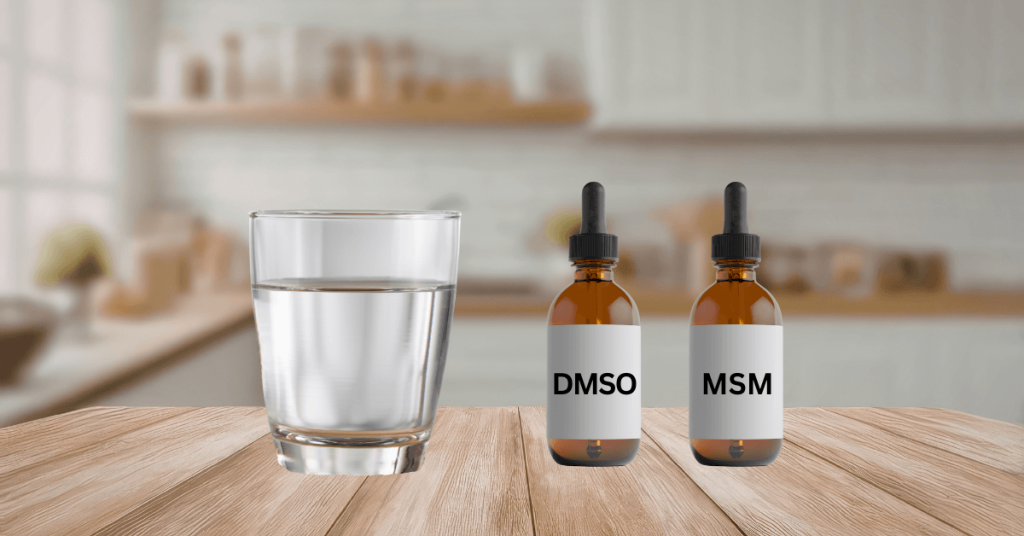
One of the most common questions we receive is: Can you mix DMSO and colloidal silver?
The short answer is yes, you can.
The better question is whether you should.
Over the years, countless colloidal silver enthusiasts have experimented by combining colloidal silver with DMSO, MSM, hydrogen peroxide, vitamin C, capsaicin, dextrose, and a variety of other substances. Some protocols recommend it. Some practitioners swear by it. Others strongly advise against it.
So who’s right?
As with many things involving colloidal silver, the answer isn’t quite as simple as many people would like it to be.
At The Silver Edge, we’ve always preferred to keep things safe and simple. While everyone has the right to make their own decisions regarding their health, our general recommendation has been to use colloidal silver by itself whenever possible.
Here’s why.
Why People Mix DMSO and Colloidal Silver
DMSO (Dimethyl Sulfoxide) has developed a reputation as a powerful carrier compound.
Many people believe DMSO can help transport other substances deeper into tissues, making it popular in a variety of topical applications. As a result, some individuals have begun combining DMSO with colloidal silver in hopes of increasing the effectiveness of the silver.
The theory is straightforward:
If colloidal silver is beneficial, and DMSO helps carry substances deeper into the body, then combining the two should produce even better results.
At least in theory.
Unfortunately, biology is rarely that simple.
What Happens When You Mix Colloidal Silver With Other Substances?
One of the most overlooked aspects of colloidal silver is the fact that silver particles and silver ions are highly reactive.
They don’t simply float around indefinitely without interacting with their environment.
Silver naturally binds to many different compounds, including proteins, sulfur-containing compounds, chloride ions, and numerous other substances found both inside and outside the body.
When additional substances are introduced into a colloidal silver solution, there is a high probability that the silver particles may begin interacting with those substances.
This can cause the silver particles to agglomerate, which simply means they begin clustering together into larger particles.
When this occurs, the original characteristics of the colloidal silver solution may change significantly.
Particle size may increase, and dispersion may decrease.
The ratio of ionic silver to metallic silver may shift.
And the solution may no longer behave the same way it did before the additional ingredients were introduced.
This is one of the primary reasons we generally recommend taking colloidal silver by itself, preferably on an empty stomach.
The fewer variables involved, the easier it is to know exactly what you’re working with.
The Sulfur Connection
When discussing DMSO and colloidal silver, it’s impossible to avoid discussing sulfur.
DMSO contains sulfur.
MSM contains sulfur.
In fact, the “S” in both names stands for sulfur.
This is important because silver has a well-known affinity for sulfur-containing compounds.
In chemistry, silver readily reacts with sulfur to form silver sulfide. This is the same chemical process responsible for tarnishing silver jewelry and silverware over time.
The same attraction between silver and sulfur raises an important question:
What happens when sulfur-containing compounds are routinely combined with colloidal silver inside the body?
The honest answer is that we don’t know everything.
However, we do know enough to be cautious.
An Interesting Observation From an Argyria Specialist
Many years ago, we had the opportunity to interview Dr. Alison Vidimos of the Cleveland Clinic.
Dr. Vidimos is well known for her work treating argyria, a rare condition in which silver deposits accumulate in the skin, causing a bluish-gray discoloration.
During that conversation, she made an observation that caught our attention.
She noted that many of the argyria patients she had encountered reported using colloidal silver together with MSM.
Now, to be absolutely clear, this observation does not prove that MSM causes argyria.
Nor does it prove that DMSO causes argyria.
Correlation does not equal causation.
However, when a physician who specializes in treating argyria notices a recurring pattern among her patients, it’s worth paying attention.
For us, that observation reinforced our long-standing preference for avoiding unnecessary combinations involving colloidal silver and sulfur-containing compounds.
What About Topical Use?
Supporters of DMSO often argue that topical applications are different.
They claim DMSO can help carry silver particles deeper into the skin, potentially improving effectiveness.
Perhaps.
But this raises another question:
Is deeper always better?
Many people assume that driving substances deeper into tissues automatically improves outcomes.
Unfortunately, biology doesn’t always work that way.
One concern involves the possibility of silver becoming trapped within deeper layers of the skin.
Silver particles that migrate into the dermis may have fewer opportunities to be naturally shed along with surface skin cells.
This raises legitimate questions about long-term accumulation.
Again, this does not mean everyone who uses DMSO and colloidal silver topically will develop argyria.
Far from it.
But it does mean we prefer a more conservative approach.
We regularly use colloidal silver topically for minor cuts, scrapes, burns, scalp conditions, and other routine applications.
We simply don’t see a compelling reason to force silver deeper into tissues than it would naturally travel on its own.
How Does the Body Normally Transport Silver?
This is one of the most misunderstood aspects of colloidal silver.
Many people assume silver simply floats through the bloodstream randomly until it encounters a pathogen.
That’s not what appears to happen.
Research suggests that silver ions may bind to naturally occurring transport proteins known as metalloproteins.
These proteins are specifically designed to bind and transport metal ions throughout the body.
In other words, your body already possesses sophisticated transport mechanisms capable of moving metal ions where they’re needed.
You can learn more about this process in our article on metalloproteins and silver transport.
This is one reason we generally question the need for exotic delivery systems.
The body has been transporting essential metal ions for millions of years.
It may not require as much “help” as some people assume.
The Long History of Colloidal Silver Fads
If you’ve been around the colloidal silver community long enough, you’ve probably noticed that certain trends come and go.
Years ago, MSM and colloidal silver were extremely popular.
Then people began promoting colloidal silver with vitamin C.
Later came hydrogen peroxide.
Then capsaicin.
More recently, some groups have promoted mixing colloidal silver with dextrose in an attempt to convert ionic silver into metallic silver particles, often referred to as “true colloidal silver.”
This is where things start getting particularly strange.
The irony is that silver’s antimicrobial activity is generally believed to be associated primarily with silver ions.
Even many silver nanoparticle researchers acknowledge that nanoparticles derive much of their activity from the release of silver ions.
So intentionally converting silver ions into larger metallic particles may actually force the body to work harder to obtain the same ionic activity that was already present to begin with.
Sometimes the simplest approach really is the best one.
What Does the Scientific Literature Say?
Silver has been extensively studied for its antimicrobial properties.
Researchers have investigated its effects against bacteria, fungi, and viruses for well over a century.
Today, silver continues to be used in wound dressings, antimicrobial coatings, water purification systems, catheters, and numerous medical devices.
Rather than relying on a single source, we’ve compiled hundreds of published clinical studies, laboratory investigations, and peer-reviewed papers that collectively provide one of the most comprehensive online collections of scientific research on silver and its antimicrobial properties.
What you won’t find, however, are large-scale human clinical trials demonstrating that mixing colloidal silver with DMSO provides superior outcomes compared to colloidal silver alone.
The evidence simply isn’t there.
That doesn’t mean such benefits are impossible.
It simply means they have not been adequately demonstrated.
Our Position
People often ask us what they should do.
Our answer is simple.
We prefer colloidal silver by itself.
Not because we’re opposed to experimentation.
Not because we’re afraid of innovation.
And certainly not because we think we know everything.
We simply believe there is value in preserving the integrity of the original solution and minimizing unnecessary variables.
The body already possesses remarkable systems for transporting, utilizing, and eliminating substances.
Whenever we introduce additional compounds, we also introduce additional unknowns.
In our experience, simplicity often produces the best results.
Final Thoughts
Can you mix DMSO and colloidal silver?
Yes.
Should you?
That’s a decision every individual must make for themselves.
For our part, we prefer to use colloidal silver in its original form without adding sulfur-containing compounds, carrier agents, or other additives.
We’ve watched countless colloidal silver trends come and go over the decades.
Some disappear as quickly as they arrive.
Others become widely accepted.
But one principle has remained remarkably consistent: When it comes to colloidal silver, simpler is often better.
Just because two substances can be mixed doesn’t necessarily mean they should be.
And when it comes to preserving colloidal silver particle integrity, minimizing agglomeration, and avoiding unnecessary risks, we believe caution is often the wisest course.
Putting This Into Practice
If you’re going to use colloidal silver, we believe the best approach is to start with a high-quality solution and avoid unnecessary additives whenever possible.
The Micro-Particle Colloidal Silver Generator was specifically engineered to produce extremely small, consistent particles with a high percentage of active silver ions—batch after batch.
By making your own colloidal silver at home, you control the quality, freshness, concentration, and ingredients. Most importantly, you know exactly what’s in it—and what isn’t.
If you’d like to learn more about producing your own high-quality colloidal silver, click here to see how the Micro-Particle Colloidal Silver Generator works.
Share Your Experience
Have you ever used colloidal silver with DMSO, MSM, or other additives? We’d love to hear about your experiences and observations.
Join The Silver Edge Community on Facebook and let us know your story!
Helpful Links:
FREE – New Colloidal Silver Safe Dosage Manual
Make Your Own Colloidal Silver for Pennies
.9999 Pure Silver Wire for Making Colloidal Silver
No reproduction without the expressed written permission of The Silver Edge.


